Serving the Golden Strip — Simpsonville, Mauldin, Fountain Inn, and Five Forks — with concrete built for upstate clay.
Call (555) 555-5555Or call — we answer. No obligation, honest advice.
The Golden Strip has been one of South Carolina's fastest-growing corridors for two decades, and all that growth stands on the same piedmont red clay that's been shaping upstate construction since the mills. Clay that swells with winter rain and shrinks through August. Subdivisions built at speed on graded lots where cut met fill. And thousands of driveways, patios, and pool decks negotiating with both — some winning, some visibly not.
Simpsonville Concrete Pros builds and repairs for these exact conditions. New driveways with the base and joints the clay demands, patios and outdoor living spaces for a market that entertains outdoors nine months a year, pool decks that stay flat and drain right, and repair work that reads the failure correctly before pricing the fix.
Free written estimates across the Strip. Call (555) 555-5555 with the project or the problem, and get a spec on paper instead of a number in the air.
When subdivisions go up fast, lots get sculpted — high side cut down, low side filled in. Concrete poured over the cut side sits on undisturbed ground and behaves. Concrete over the fill side sits on soil that may have been compacted well, indifferently, or not at all, and fifteen years later the driveway tells you which.
That's why so much of the Strip's newer flatwork shows settlement on one end and not the other. Reading the lot's cut-and-fill history is the first step of every estimate here — it predicts where the trouble is and where it's headed.
Three services cover the corridor's needs, from new construction extras to boom-era repairs. Each links to its own page.
New driveways, replacements, and extensions with compacted base and joint plans matched to red clay's annual cycle.
Patios, pool decks, walkways and stamped or finished outdoor spaces for a market that lives outside most of the year.
Settlement triage, crack repair, and honest replace-vs-repair calls — with the cut-and-fill diagnosis done first.
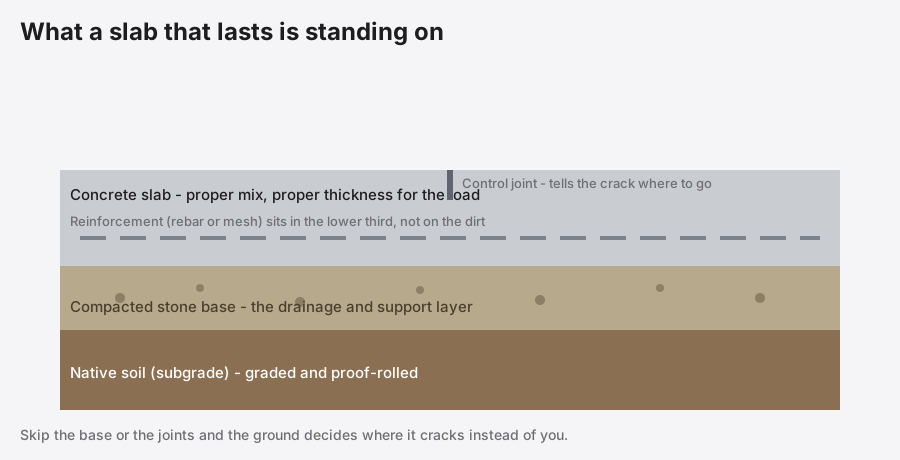
Good concrete is a system, and most of the system is invisible by the time you're standing on it. Compacted subgrade at the bottom, a stone base that spreads loads and drains water, reinforcement placed where it actually fights cracking, proper thickness for the traffic, and control joints that give the slab a dignified place to move.
On upstate clay, the base layer is the difference-maker. Red clay's yearly swell-and-shrink cycle puts every slab through a slow-motion stress test, and the stone base is what keeps that movement from printing itself through your driveway. Builders in a hurry sometimes thin it; the clay always finds out.
When bids land on your kitchen table, the question that sorts them is never the price per square foot — it's what's specified underneath. Any bid that doesn't say is telling you anyway.
Here's a pattern every fast-growing corridor knows: production builders pour functional concrete to schedule and budget — a driveway, a walk, a small patio pad — and it's fine, in the way base-model anything is fine. Then the homeowner lives there two years and wants what the neighborhood actually uses: the extended patio, the grill pad, the pool deck, the wider driveway that fits the third car.
That second wave of concrete is a different craft. It has to match into existing pours cleanly, handle grades the builder's landscaping created, and look intentional rather than added-on. Expansion joints where new meets old, finishes that blend or deliberately contrast, and drainage that accounts for how the yard actually behaves after two years of settling — that's the difference between an addition and a patch.
The Strip's outdoor-living market rewards doing this well. A pool deck or patio here isn't a slab; it's the room the house uses from March to November, and it gets designed like one.
And a standing recommendation for hiring anyone in this trade, us included: verify. South Carolina registers residential specialty contractors, and any legitimate company can have its insurer send a certificate of insurance directly to you. License lookup plus insurance certificate plus written spec — that's the whole screen, and it takes ten minutes.
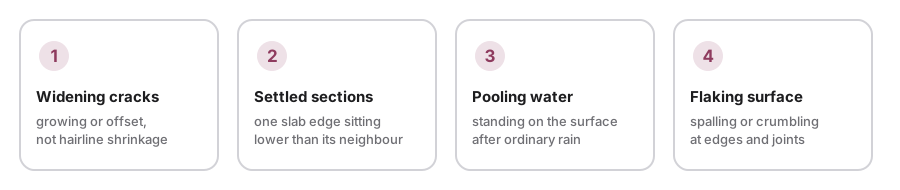
Widening cracks, settled sections, pooling water, and flaking surfaces — on boom-era lots, the settled section is the one to watch, because it's usually the fill side of the lot reporting in.
The same process for a driveway off Fairview Road or a pool deck in Five Forks.
Cut-and-fill history, drainage behavior, and what existing concrete is already saying — evaluated before any number exists.
Base depth, thickness, reinforcement, joints, and finish, written down so bids compare on substance and the job has a contract-grade record.
This market notices workmanship. Edges, joint lines, and surface finishes get treated as the visible signature they are.
The Golden Strip's growth has been residential, but it's the outdoor-living kind of residential — screened porches, pools going in behind privacy fences, patios sized for entertaining. Concrete is the floor of all of it, and the corridor's climate is generous: a well-built patio here earns its keep from early spring past Thanksgiving.
Pool decks are their own discipline inside that market. They need slip-resistant finishes that stay comfortable barefoot in July, drainage that moves splash-out and storm water away from both pool and house, and joint plans that handle clay movement without cracking through the deck everyone looks at all summer. Deck-and-coping coordination with pool contractors is part of the job, not an extra.
Fountain Inn and Mauldin round out the corridor with the same appetite and their own housing mixes — Fountain Inn's growth is newer still, and Mauldin carries more mature stock with mature-stock repair needs. One crew, one standard, the whole Strip.
Walkways and front-entry concrete carry the corridor's curb-appeal weight, and they age in public. A cracked entry walk undercuts a house that's otherwise immaculate, and replacing one is a one-day job that photographs like a renovation.
Based in Simpsonville and covering the Golden Strip and its edges — Mauldin, Fountain Inn, Five Forks, and the southern Greenville County communities between the corridor and the lake country.
Just outside the lines? Call anyway — the Strip's edges blur, and so does the service area.
Heart of the Golden Strip in southern Greenville County, one of the upstate's fastest-growing corridors.
Upstate red clay is honest, at least: it does the same thing every year. Winter rains swell it; late-summer drought shrinks it away from slab edges; and any concrete that wasn't built to ride that cycle accumulates the damage a season at a time. It's why a 1990s driveway with real base under it can outlast a 2010s driveway without one, and why the age of failing concrete on the Strip surprises people — newer doesn't mean better-built.
The clay also punishes drainage mistakes with interest. Water directed against a slab edge softens the clay below it; the softened clay lets the edge settle; the settled edge collects more water. Half the corridor's flatwork problems trace back to a downspout, a grade, or a neighbor's runoff, which is why every estimate here starts by watching where the water wants to go.
None of this is a reason to fear concrete on clay — it's the reason to build it correctly once. Done right, the clay and the slab reach a truce that lasts decades.
A driveway showing its fill-side settlement, a patio project sketched on a napkin, a pool deck that needs to be ready by Memorial Day, or builder-grade concrete ready for its upgrade — call (555) 555-5555 and describe it. Free written estimate, real spec, real schedule.
On the Golden Strip, the ground and the growth are both permanent. The concrete should be too.
Tell us what you need and we'll get back to you with a real answer. If it's an active backup or standing water over the field, calling gets you a faster response.
Call: (555) 555-5555
Area: Simpsonville, SC and Greenville County